
Let’s be honest: applying to study in the UK is expensive. Between application fees, visa costs, and health surcharges, your budget is already stretched thin. For students from countries like Nigeria, India, or Ghana, the cost of an English proficiency test—roughly $200 to $260 USD—is a significant investment.
The hard truth is that many capable students waste money by booking the wrong test or assuming their high school English results (like WAEC or CBSE) are automatically sufficient. They aren’t always.
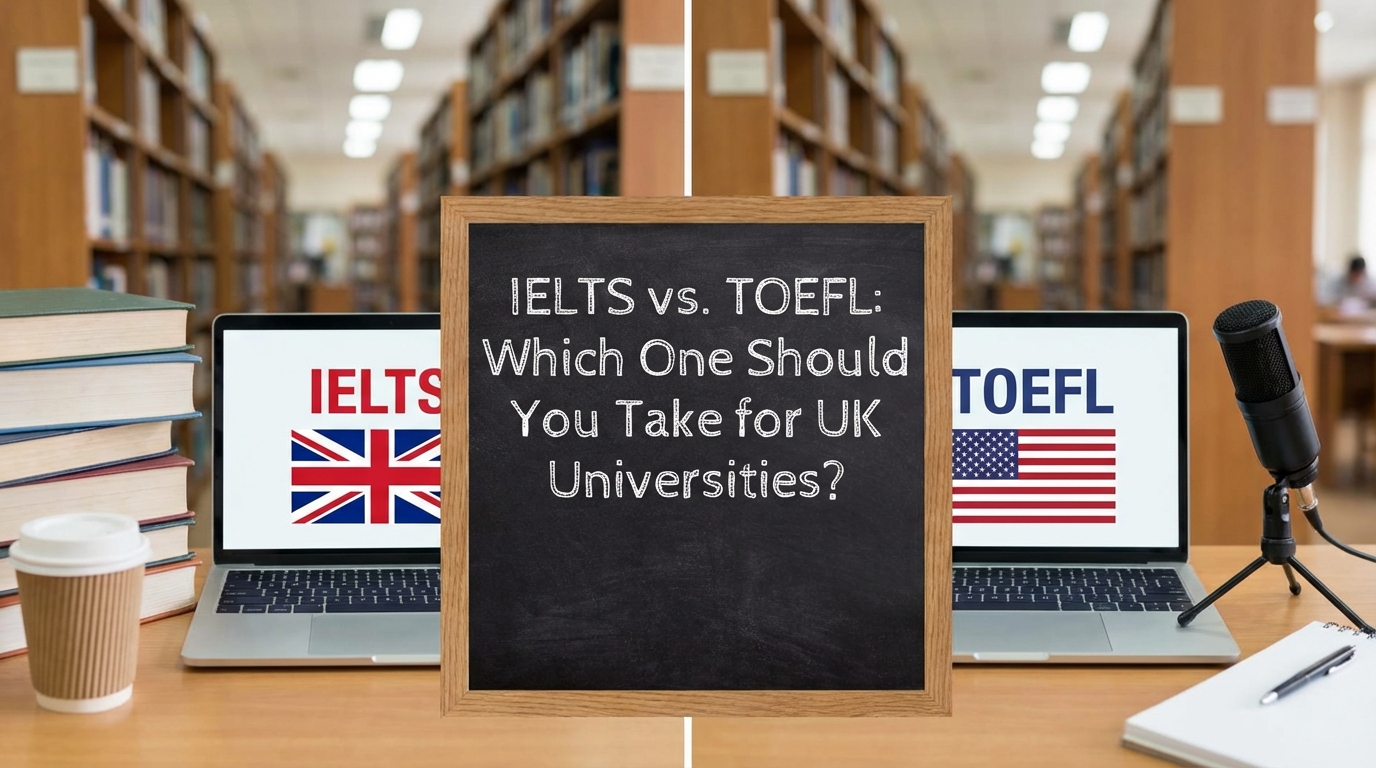
In this guide, you will learn exactly how to choose between IELTS and TOEFL specifically for UK admissions. We will cut through the marketing noise and focus on what the UK Home Office (UKVI) and admissions officers actually require.
Step 1: Understand the “UKVI” Factor
Before you look at test formats, you must understand the most critical regulation for UK study: the Secure English Language Test (SELT) requirement.
If you are applying for a Student Visa, the UK government has a strict list of approved tests.
- IELTS: There is a specific version called “IELTS for UKVI.” It is exactly the same exam as the standard IELTS Academic in terms of content, but it is taken in a facility with higher security measures (cameras, etc.) approved by the UK government.
- TOEFL: TOEFL iBT is widely accepted by UK universities for degree-level courses (Bachelor’s, Master’s, PhD). However, if you are doing a “Pre-sessional” English course or a Foundation year (below degree level), TOEFL might not be accepted for the visa application.
The Bottom Line:
- If you are applying directly for a Master’s or Bachelor’s degree: You can usually use TOEFL iBT or Standard IELTS Academic.
- If you are applying for a Foundation Year or Pre-Master’s: You almost certainly need IELTS for UKVI (Academic).
Pro Tip: When in doubt, book the IELTS for UKVI (Academic). It costs slightly more than the standard IELTS, but it is universally accepted for every type of UK visa and university course. It is the “safest” bet if you haven’t finalized your university choice yet.
Step 2: Compare the Test Formats (Play to Your Strengths)
You are investing a lot of money; choose the format that suits your personality and skills.
IELTS Academic (International English Language Testing System)
- Format: Paper-based or Computer-delivered.
- Speaking Section: Face-to-face interview with a real human examiner.
- Content: A mix of accents (British, Australian, American). Graphs and diagrams are common in the writing section.
- Best for: Students who feel more comfortable talking to a person than a screen, or those who prefer handwriting their essays (if taking the paper-based version).
TOEFL iBT (Test of English as a Foreign Language)
- Format: 100% Computer-based.
- Speaking Section: You speak into a microphone. Your responses are recorded and graded later.
- Content: Predominantly North American accents and academic content. The questions are often integrated (e.g., “Read this text, listen to this lecture, then speak about the relationship between them”).
- Best for: Students with fast typing speeds and those who get nervous speaking face-to-face.
Pro Tip: If you have slow typing speed or struggle with strict computer timers, avoid TOEFL. The IELTS paper-based option is a lifesaver for students who are used to written exams in their home country’s education system.
Step 3: Analyze the Scoring and “Fail” Risks
Universities usually ask for an overall score and minimum scores in each section (Reading, Writing, Listening, Speaking).
- IELTS: Scored on a Band system (1–9).
- Typical Requirement: 6.5 Overall (with no band less than 6.0).
- TOEFL: Scored out of 120.
- Typical Requirement: 88–90 Overall (with specific minimums like 20+ in Writing).
The “Section” Risk: It is common for students to get a high overall score but miss the mark in one section (often Writing).
- IELTS writing criteria can be very strict regarding structure.
- TOEFL writing focuses heavily on how well you synthesize information from audio and text.
Pro Tip: Check the specific department requirements, not just the general university requirement. A Law or Journalism department often requires a higher score (e.g., IELTS 7.5) compared to an Engineering department (IELTS 6.0 or 6.5).
Step 4: Infrastructure and Logistics (Critical for Developing Countries)
This is rarely discussed but vital for students in Nigeria, India, or Pakistan.
1. Internet Stability
- TOEFL Home Edition: You can take this from your bedroom. However, you need a flawlessly stable internet connection and a private room. If your power cuts or internet drops (common in Lagos or Mumbai during storms), your test can be terminated, and you may lose your fee.
- IELTS: You go to a center. If the power goes out there, it is the test center’s responsibility, not yours.
2. Availability
- IELTS: Has a massive footprint with physical centers in major cities across Africa and Asia.
- TOEFL: Physical centers exist but are sometimes less frequent than IELTS centers in certain regions.
Pro Tip: Do not take the Home Edition of any test unless you have a backup power generator (inverter/UPS) and a dedicated fiber optic line. The risk of technical disqualification is too high.
Common Mistakes to Avoid
- Booking “General Training” instead of “Academic”: IELTS has two modes. “General Training” is for migration (work visas). “Academic” is for university. If you submit a General Training score for a Master’s degree application, it will be rejected immediately. You will have to pay and take the test again.
- Assuming the “English Waiver” Applies to You: Some UK universities waive the test if you have a high grade in WAEC (West Africa), NECO, or Class XII English (India). However, this varies strictly by university. Do not assume. If you arrive at the visa stage and the UKVI demands a SELT because your waiver wasn’t strong enough, your visa will be delayed.
- Sending Scores Late: It takes roughly 13 days to get IELTS results and 6-10 days for TOEFL. Do not take the test two weeks before your application deadline. You need a buffer for potential delays or—worst case scenario—a retake.
FAQ
Q: Can I combine my scores from two different test dates (MyBest Scores)? A: TOEFL offers a feature called “MyBest Scores” which combines your highest section scores from the last two years. However, many top-tier UK universities do not accept this. They often require you to hit the minimum requirements in a single sitting. Always verify this policy with the admissions office.
Q: How long are my results valid? A: Both IELTS and TOEFL scores are valid for two years from the test date. If you took the test in 2023 for an application in late 2026, your scores will likely be expired, and you will need to retake the exam.
Q: If I fail the test, how soon can I retake it? A:
- IELTS: You can retake it as soon as the next test date is available. There is no waiting period.
- TOEFL: You must wait 3 days between tests.
- Note: It is rarely wise to retake immediately without addressing the reason you scored low the first time.