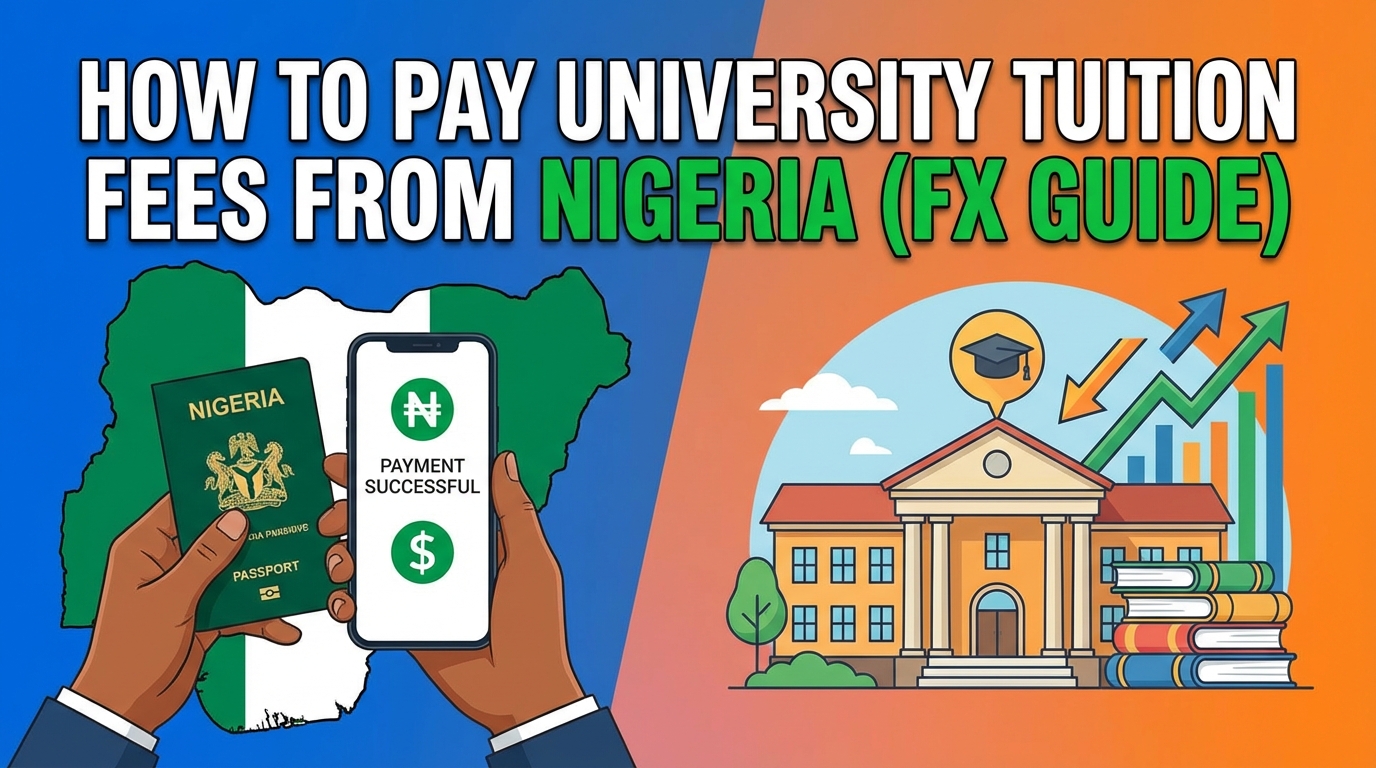
For Nigerian students, securing admission is often the easy part. The real battle begins when you try to pay your tuition. With the fluctuating Naira, the gap between the Central Bank of Nigeria (CBN) “official” rate and the parallel market rate, and the unpredictable processing times for international transactions, paying fees can feel like navigating a minefield.
Here is the reality check: The days of using your standard Naira debit card to pay thousands of dollars/pounds for tuition are largely over. Most Nigerian banks have suspended or severely limited international spending on Naira cards. To pay your fees in 2026, you must be strategic, proactive, and willing to navigate complex banking protocols.
In this guide, you will learn the three most reliable methods to move money across borders: the government-subsidized “Form A” route, the Domiciliary Account method, and authorized global payment aggregators. We will focus on safety, speed, and cost-efficiency to ensure your enrollment is never at risk.
Step 1: The “Form A” Route (Official CBN Rate)
This is the most coveted method because it uses the official exchange rate, which is typically lower than the parallel market rate. However, it requires patience. Processing times can range from 2 weeks to 3 months depending on FX availability.
How it Works: You apply through the CBN’s “Trade Monitoring System” (TRMS) portal. Your bank bids for the FX on your behalf and pays the university directly.
Requirements:
- Valid Admission Letter: Must be unconditional (or conditional only on payment).
- Tuition Invoice: Clearly stating the amount and the university’s bank details (IBAN/SWIFT).
- NIN (National Identification Number): Mandatory for all banking transactions.
- BVN (Bank Verification Number): Must match your personal details exactly.
- Tax Clearance Certificate: Often required for the sponsor (parent/guardian) to prove legitimacy of funds.
Pro Tip: Do not wait until the payment deadline. Initiate the Form A process at least 60 days before your fees are due. If the bank cannot source the FX in time, you will need a backup plan immediately.
Step 2: The Domiciliary Account Method (Fastest & Most Reliable)
If speed is your priority and you cannot wait for the CBN queue, a Domiciliary (Dom) Account is the standard solution. This involves opening a foreign currency account (USD, GBP, or EUR) in Nigeria.
How it Works: You source the foreign currency yourself (usually cash from the parallel market or an inflow from a relative abroad), deposit it into your Dom account, and instruct your bank to make a wire transfer (Telegraphic Transfer) to the university.
Requirements:
- Two Current Account Referees: Required to open the account.
- Cash Deposit or Inflow: You purchase FX from a Bureau de Change (BDC) and deposit the cash.
- Transfer Charge: Banks typically charge a fee (approx. 0.5% to 1% of the transaction value) plus VAT.
Pro Tip: Ask your bank for the “Cash Handling Charge” status. Some banks charge extra if you deposit cash and then immediately try to transfer it. It is often cheaper to have someone transfer the funds electronically into your Dom account if possible.
Step 3: Using University-Approved Aggregators (Flywire/Convera)
Most international universities partner with payment processors like Flywire or Convera (formerly Western Union Business Solutions). These platforms allow you to pay in your local currency (sometimes) or track your payment transparently.
How it Works:
- Log in to your university student portal.
- Select “Pay Fees” and choose the aggregator (e.g., Flywire).
- Select “Nigeria” as the country.
- They will provide specific bank instructions. You often transfer the funds to their local Nigerian partner bank, and they handle the conversion and settlement abroad.
Why Use This:
- Transparency: You can track exactly when the money reaches the school.
- Compliance: These platforms are fully integrated with the university’s finance department, reducing the risk of “missing payments.”
Pro Tip: Compare the exchange rate offered by Flywire/Convera against the open market rate. Sometimes their “convenience” rate is higher than if you simply sourced the dollars yourself and wired them.
Step 4: The “Sponsor Abroad” Option
If you have a trusted relative in the UK, US, or Canada, this is often the stress-free path.
How it Works: You pay the Naira equivalent to your relative’s Nigerian account (or their family’s account), and they pay the university directly from their foreign bank account.
The Risk: You must ensure the university accepts “Third Party Payments.” Due to anti-money laundering (AML) laws, some universities reject payments that do not come from the student or their registered parents.
Pro Tip: If using this method, email the university finance team before sending the money. Subject: “Third Party Payment Authorization – [Student ID].” Attach a letter from the relative confirming their relationship to you and their intent to pay your fees.
Sample/Template: “Form A” & Bank Transfer Checklist
Processing payments in Nigeria involves heavy paperwork. Use this checklist to ensure you don’t get bounced at the bank branch.
The “Form A” / Transfer Document Checklist:
- [ ] The Invoice: Must be final (not a quote). Ensure it has the university’s IBAN, SWIFT/BIC Code, and Beneficiary Name clearly printed.
- [ ] Admission Letter: Must be on official letterhead.
- [ ] Trade System (TRMS) Profile: Have you created your profile on the CBN Trade System portal? (Yes/No)
- [ ] Passport Copy: Data page of your international passport.
- [ ] Indemnity Form: Most banks require you to sign a form indemnifying them against FX fluctuations.
- [ ] Debit Authorization: A physical letter instructing the bank to debit your Naira or Dom account.
- [ ] Tax Clearance: (If applicable) Copy of your sponsor’s Tax Identification Number (TIN) or clearance certificate.
Common Mistakes to Avoid
- Using “Black Market” Agents for Direct Payments: Never give your tuition money to a random “agent” who promises to pay the school for you. This is a common scam. If the money comes from a compromised account, the university will freeze your enrollment and return the funds, leaving you in debt.
- Ignoring the “Value Date”: International transfers take time (usually 2-5 business days). If your deadline is February 15th, do not initiate the transfer on February 14th. The money must land in the university’s account by the deadline, not just leave yours.
- Mismatched Names: Ensure the name on the bank transfer matches your student record exactly. If your uncle pays, the reference field MUST contain your Student ID Number and Full Name. If this is missing, the money sits in the university’s “Suspense Account” and your fees remain unpaid.
FAQ
1. Can I use my Naira Master/Visa card to pay fees online? As of early 2026, most Nigerian banks have a monthly international spend limit (often $20-$50) on standard Naira cards, which is insufficient for tuition. You generally cannot use a standard Naira card for large tuition payments. You must use a Form A or a Domiciliary card.
2. What happens if I pay via Form A and the exchange rate changes while I am waiting? You are usually charged the rate on the day the transaction is executed, not the day you applied. If the Naira devalues while your application is sitting in the queue for 3 weeks, you will pay the higher rate. You must keep extra funds in your account to cover this fluctuation.
3. The university wants a “Wire Confirmation.” What is that? This is the SWIFT MT103 document. It is a digital receipt your bank generates once the money has actually been sent abroad. Always demand this document from your bank officer; it is the only proof you have that the money has left Nigeria.