In Nigeria, India, or Ghana, we are taught that a “Curriculum Vitae” (CV) is a comprehensive history of our entire lives. We list every primary school attended, every certificate earned, our date of birth, our religion, and sometimes even our local government area. We think the more information we provide, the more impressive we look.
In the Western job market, specifically for part-time jobs, this approach is fatal.
If you hand a 4-page academic CV to a manager at a coffee shop in London or a warehouse in Toronto, they will throw it in the trash. They do not care about your research paper on “Macro-economic Trends in West Africa.” They care about one thing: Can you stand on your feet for 8 hours and be polite to rude customers?
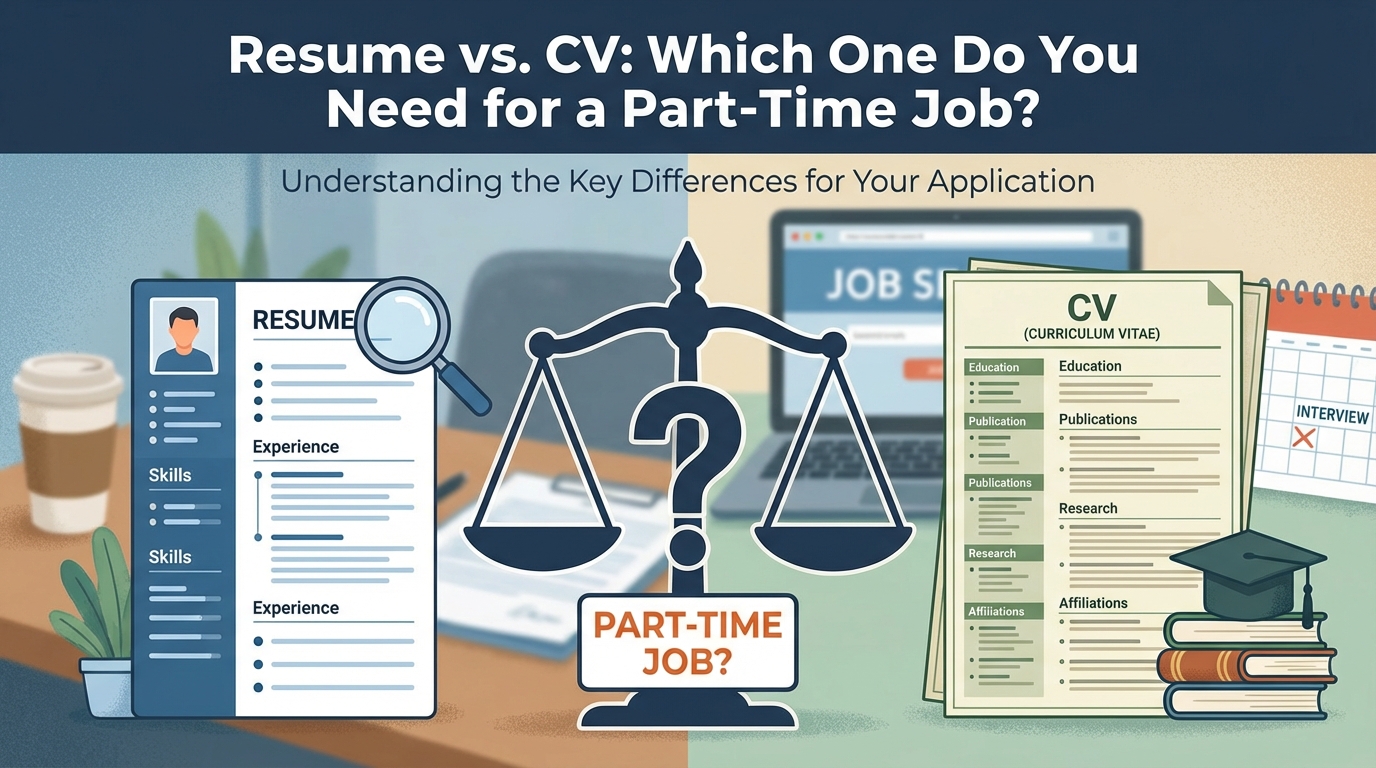
The confusion is linguistic, too. In the UK and Europe, it is called a CV. In the USA and Canada, it is called a Resume. But regardless of the name, the function for a part-time job is the same: it must be short, relevant, and free of “bio-data” clutter.
In this guide, you will learn how to strip down your academic achievements to create a “Survival Job” document that gets you hired quickly, so you can start paying your bills.
Step 1: Know Your Geography (CV vs. Resume)
First, let’s clarify the terminology, because it changes depending on where your plane lands.
The USA and Canada
- Term: Resume.
- Length: Strictly 1 Page.
- Content: Only relevant work history and skills. No personal details.
- Purpose: Marketing document. “Here is why I can do this specific job.”
The UK, Ireland, and New Zealand
- Term: CV.
- Length: 2 Pages maximum (for students).
- Content: Slightly more detailed, but still focused.
- Purpose: Competency proof.
The “Academic CV” (Global)
- Term: CV.
- Length: Unlimited (5+ pages).
- Content: Publications, research, conferences.
- Purpose: Getting a PhD or a Research Assistant role.
- Verdict: Never use this for a part-time job.
Pro Tip: If you are in the US/Canada, set your page margins to “Narrow” (0.5 inches) to fit more content on one page without it looking crowded.
Step 2: The “Bio-Data” Purge (Delete These Immediately)
In many developing countries, adding personal details is standard practice. In the West, it is often illegal for employers to ask for these, and including them makes you look naive or unaware of cultural norms.
Open your current CV and DELETE the following:
- Photo: Unless you are applying for acting or modeling. In the US/UK, photos on resumes can lead to immediate rejection due to anti-discrimination laws.
- Age / Date of Birth: Ageism is real. Do not list it.
- Marital Status: Irrelevant.
- Religion: Irrelevant.
- Gender: Irrelevant.
- Local Address (Home Country): If you are applying for a job in Manchester, do not list an address in Lagos. It confuses the ATS (Applicant Tracking System). Use your local UK address, or just “Manchester, UK.”
Step 3: The “Overqualification” Trap
This is the hardest pill to swallow. You are proud of your Master’s degree. You should be. But if you are applying to be a Shelf Stacker at Walmart, your Master’s degree makes you a “flight risk.”
The manager thinks: “This person is too smart. They will get bored and quit in two weeks when they find a better job.”
How to fix it:
- Tone it down: If you are applying for a warehouse job, you don’t need to list your “Executive Leadership” seminar. List your “Safety Certification” or “Physical Stamina” instead.
- Focus on “Transferable Skills”: Instead of listing “Python Programming,” list “Inventory Management” or “Customer Service.”
Pro Tip: Create two versions of your resume.
- The “Career” Resume: For internships in your field (keep the Master’s/Honors prominent).
- The “Survival” Resume: For retail/hospitality (focus on availability, reliability, and hard work).
Step 4: Structuring the Document
For a student with little “official” work experience, use this structure:
- Header: Name, Local Phone Number, Email, LinkedIn (Optional), City.
- Professional Summary: 2-3 sentences. “Reliable student with experience in…”
- Availability (Crucial): For part-time jobs, when you can work is more important than what you know.
- Experience: Reverse chronological order.
- Education: Keep it at the bottom.
How to handle “No Experience”: If you have never held a formal job, use your volunteer work.
- Did you usher at your church? That is “Event Staff / Crowd Control.”
- Did you sell clothes for your aunt? That is “Sales Associate.”
- Did you organize a campus event? That is “Project Coordinator.”
Pro Tip: For the “Availability” section, be specific. Write: “Available: Weekdays after 4 PM, Weekends: All day.” This saves the hiring manager time and increases your chances of a callback.
Sample/Template: The “Survival Job” Resume
Copy this into a Word Doc or Google Doc. Keep it to one page.
Plaintext
[YOUR NAME]
[City, Country e.g., Toronto, ON] | [Phone Number] | [Email Address]

PROFESSIONAL SUMMARY
Energetic and reliable university student with a strong work ethic and a focus on customer satisfaction. Proven ability to work in fast-paced environments, handle cash transactions accurately, and maintain a clean workspace. Available for evening and weekend shifts immediately.

AVAILABILITY
- Monday - Friday: After 4:00 PM
- Saturday - Sunday: Open availability (Any shift)

WORK EXPERIENCE

Customer Service Volunteer | [Name of Organization/Church/Mosque]
[City, Country] | [Dates, e.g., Jan 2022 – Dec 2023]
- Managed front-desk inquiries for weekly events attended by 200+ community members.
- Resolved conflict calmly and efficiently, ensuring a welcoming environment for guests.
- Assisted with setup and breakdown of chairs and equipment, demonstrating physical stamina.

Sales Assistant (Family Business) | [Name of Business]
[City, Country] | [Dates, e.g., Jun 2020 – Aug 2021]
- Processed cash and card transactions accurately using a Point of Sale (POS) system.
- Organized inventory and restocked shelves to ensure product availability.
- Greeted customers warmly and provided product recommendations, increasing daily sales by 15%.

Administrative Assistant (Intern) | [Company Name]
[City, Country] | [Dates]
- Managed schedules and answered phone calls in a busy office environment.
- Demonstrated punctuality and reliability by maintaining a 100% attendance record.

EDUCATION

Candidate for [Degree Name, e.g., Diploma in Business]
[College/University Name], [City] | [Expected Graduation Date]

SKILLS
- Soft Skills: Teamwork, Punctuality, Conflict Resolution, Adaptability.
- Languages: English (Fluent), [Native Language] (Fluent).
- Technical: Microsoft Office, Basic Cash Handling.
Common Mistakes to Avoid
- Using “I” Statements: Don’t write paragraphs like “I worked here and I did this.”
- Fix: Use Action Verbs. Instead of “I was responsible for cleaning,” write: “Maintained high standards of cleanliness and sanitation.”
- Listing “References Available on Request”: This is an outdated phrase that wastes valuable space.
- Fix: Delete it. If they want references, they will ask you after the interview. Use that space to add more skills or availability.
- Spelling Errors (The “Detail Oriented” Irony): There is nothing worse than writing “I am detail-oriented” and then spelling it “oreinted.”
- Fix: Do not rely on your eyes. Use spell-check. Then, read it backward (from the last word to the first) to catch typos your brain skips over.
FAQ
Q: Should I include my high school grades? A: No. If you are in university or college, your high school grades are irrelevant to a coffee shop manager. They assume you have basic math and reading skills. Just list the name of your university and your expected graduation year.
Q: Is it okay to “dumb down” my resume? A: Yes. It is not lying; it is targeting. If you are applying for a cleaning job, removing your “Advanced Certificate in Data Analytics” is smart marketing. You want to look like a long-term fit, not a temporary genius who will leave next week.
Q: Do I need a Cover Letter for a part-time job? A: Generally, no. For high-volume jobs like fast food or retail, managers don’t have time to read them. However, if you are applying for a slightly more skilled role (e.g., Campus Library Assistant or Admin Assistant), a short cover letter explaining your interest and availability can set you apart.