You have spent years perfecting your technical skills. You studied late nights to get that “A” in Advanced Calculus or learned Python until your eyes hurt. In educational systems like those in Nigeria or India, we are taught that technical excellence is the only thing that matters. If you get the right answer, you get the job.
This is false in the global market.
In the UK, USA, and Canada, technical skills are merely the “entry ticket.” They get your CV noticed. But Soft Skills are what get you the job offer—and more importantly, the visa sponsorship. I have seen brilliant data scientists from Lagos rejected because they couldn’t explain their process clearly to a non-technical manager. I have seen average coders from Mumbai land massive offers because they demonstrated incredible emotional intelligence and teamwork.
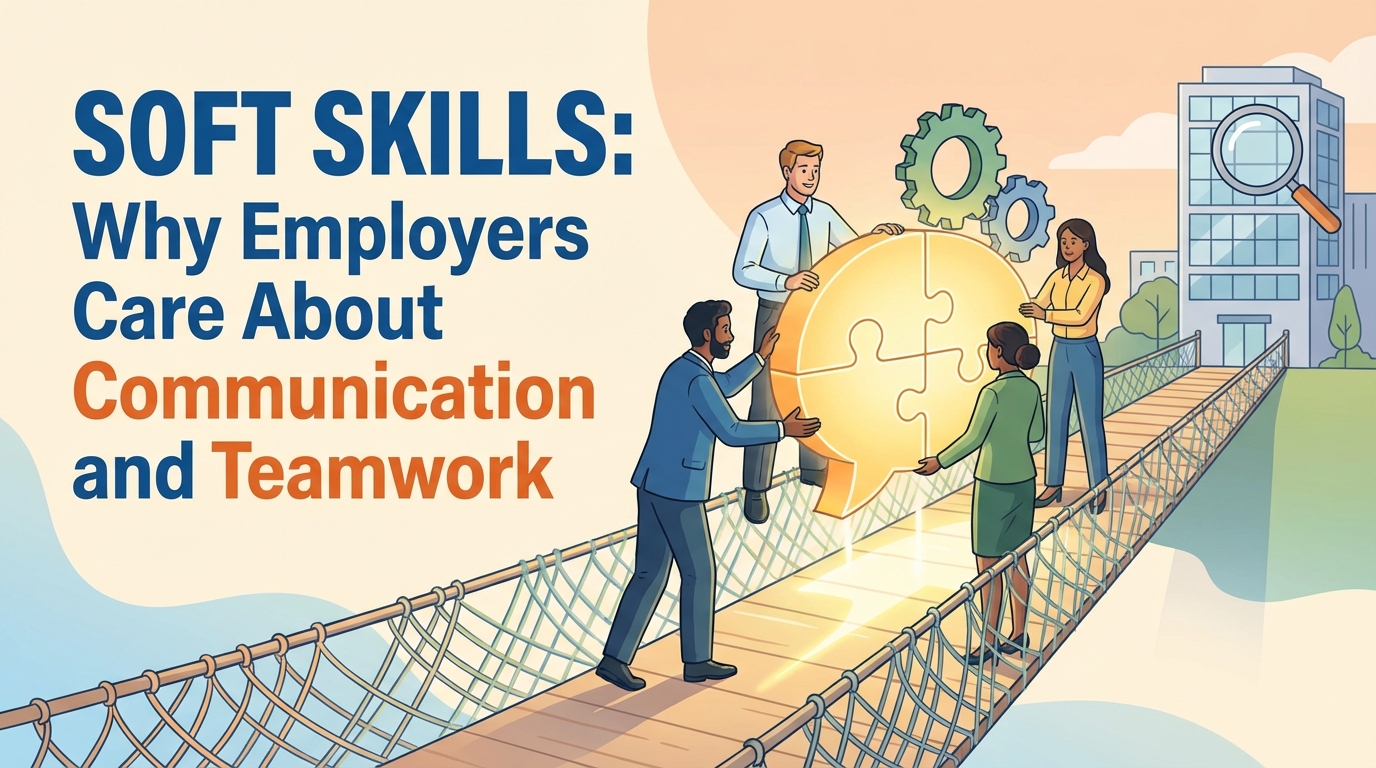
In this guide, you will learn exactly why Western employers obsess over “Communication” and “Teamwork,” and how to prove you have these skills without sounding like a cliché.
Step 1: Decode the “Cultural Translation” of Communication
“Communication” does not mean speaking perfect Queen’s English. It means the ability to transfer information efficiently.
For students from high-context cultures (like parts of Africa and Asia), this is a major hurdle.
- The “Respect” Trap: In many developing countries, it is rude to disagree with a boss or an elder. You wait to be spoken to. You use flowery, deferential language (“I humbly request…”).
- The Western Expectation: In the US or UK, this silence is often interpreted as a lack of confidence or lack of initiative. Employers want you to speak up, ask clarifying questions, and be concise.
What Employers Actually Want:
- Clarity: Can you explain a complex engineering problem to a Marketing Manager in 3 sentences?
- Active Listening: Are you listening to understand, or just waiting for your turn to speak?
- Feedback Reception: When a manager critiques your work, do you get defensive, or do you ask, “How can I improve this for next time?”
Pro Tip: Adopt the BLUF Method (Bottom Line Up Front). When emailing a Western colleague, put the conclusion or request in the very first sentence. Do not bury the ask at the end of three paragraphs of greetings.
Step 2: Redefine “Teamwork” (It’s Not Just Getting Along)
When an interviewer asks, “Are you a team player?”, most students say: “Yes, I love working with people and I never fight.”
This is a bad answer.
Western employers know that conflict is inevitable. They don’t want a team of people who agree on everything; that kills innovation. They want “Constructive Conflict.”
- The Skill: Can you disagree with a teammate’s idea without attacking them personally?
- The Skill: Can you handle a teammate who is not pulling their weight without running to the teacher/boss immediately?
Requirements to Demonstrate:
- Empathy: Understanding why a colleague is stressed.
- Reliability: Doing what you said you would do, by the deadline you promised.
- Adaptability: Stepping in to do a task that isn’t “your job” because the team needs it to cross the finish line.
Pro Tip: In group interviews (common in the UK), do not try to be the loudest voice. The evaluators are often looking for the person who says, “That’s a great idea, Priya. Maybe we can combine that with John’s suggestion?” That is a leader.
Step 3: The “Soft Skills” CV Audit
You cannot list “Good Communication Skills” under a “Skills” section on your resume. It looks like filler text. You must show, not tell.
How to integrate them:
- Instead of: “Strong leadership skills.”
- Write: “Led a team of 5 students to organize a campus hackathon, resolving scheduling conflicts and raising $500 in sponsorship.”
- Instead of: “Good communicator.”
- Write: “Presented quarterly research findings to a panel of 30 faculty members and simplified technical jargon for a non-expert audience.”
The “Verbs” to Use:
- Negotiated
- Collaborated
- Mentored
- Facilitated
- Mediated
Pro Tip: If you are freelancing online (Upwork/Fiverr), your “Soft Skills” are your response time and your ability to follow a brief. Mention in your profile: “I pride myself on clear, daily updates so you never have to guess where your project stands.”
Sample/Template: The STAR Method for Interviews
When asked behavioral questions like “Tell me about a time you had a conflict,” do not ramble. Use the STAR method (Situation, Task, Action, Result).
Copy this template and fill in your own story.
Plaintext
[INTERVIEW TEMPLATE: ANSWERING THE "CONFLICT" QUESTION]

QUESTION: "Tell me about a time you disagreed with a team member."

1. SITUATION (Set the scene - 10%)
"In my final year project, I was working with a team of four to build a mobile app. We had a strict deadline of two weeks to finalize the design."

2. TASK ( The problem - 10%)
"One team member, Tunde, wanted to use a complex design framework that would take too long to learn. I knew that if we went down that path, we would miss the deadline. The rest of the group was silent."

3. ACTION (What YOU did - 60% - Crucial Part)
"I didn't want to shut him down publicly. I scheduled a quick 1-on-1 coffee chat with him. I acknowledged that his idea was technically superior, but I laid out the timeline risks.
I proposed a compromise: We would use the simpler framework for the MVP (Minimum Viable Product) to pass the course, but we would document his complex framework in the 'Future Recommendations' chapter of our report. This validated his expertise while keeping us on schedule."

4. RESULT (The outcome - 20%)
"He agreed to the compromise. We finished the project two days early and received an 'A' grade. The professor specifically praised our realistic project management."
Common Mistakes to Avoid
- The “We” Trap: In an attempt to sound humble, candidates often say, “We did this,” or “The team achieved that.”
- Why it fails: The interviewer is hiring you, not your team. If you only say “We,” they don’t know what your specific contribution was.
- Fix: Use “I”. “The team was stuck, so I suggested…”
- Being a “Robot” (Memorized Answers): Students often memorize scripts found on Google.
- Why it fails: Communication is about connection. If you sound rehearsed, you seem inauthentic.
- Fix: Memorize your stories (the bullet points of what happened), not the exact sentences. This allows you to speak naturally.
- Ignoring Non-Verbal Cues: In a Zoom interview, looking at your phone, slouching, or not looking at the camera (eye contact) screams “disinterested.”
- Why it fails: 90% of communication is non-verbal.
- Fix: Stick a post-it note near your webcam that says “LOOK HERE.”
FAQ
Q: Can I learn soft skills, or are people just born with them? A: You can absolutely learn them. They are like a muscle. You build them by putting yourself in uncomfortable social situations. Join a Toastmasters club to practice public speaking. Volunteer for a leadership role in your student union. It will feel awkward at first, just like your first day at the gym, but you will improve.
Q: I am an introvert. Does that mean I have bad soft skills? A: No. Introversion is not a lack of social skills; it is about how you recharge your energy. Many of the best leaders are introverts because they are excellent listeners and thinkers. You do not need to be the loudest person in the room to be an effective communicator. You just need to be clear and empathetic when you do speak.
Q: Will my accent be a problem for “Communication” scores? A: An accent is rarely the problem; pronunciation and speed are. Employers in global hubs like London or Toronto are used to accents. However, if you speak too fast or mumble, they cannot understand you.
- Advice: Slow down. Enunciate your consonants. It is better to speak slowly and be understood than to speak quickly and be confusing.