Let’s face the hard truth: Securing admission to a university in the US, UK, or Canada is only half the battle. The real hurdle—the one that keeps students up at night—is the visa interview. For students from high-risk regions like Nigeria, India, or Ghana, the scrutiny is intense. You are guilty until proven innocent. The Consular Officer (VO) starts the interview assuming you are an intending immigrant, and you have roughly two to three minutes to prove them wrong.
It is a brutal system, but it is not a lottery. Rejections rarely happen “for no reason.” They happen because of specific, avoidable errors in documentation, financial presentation, or communication.
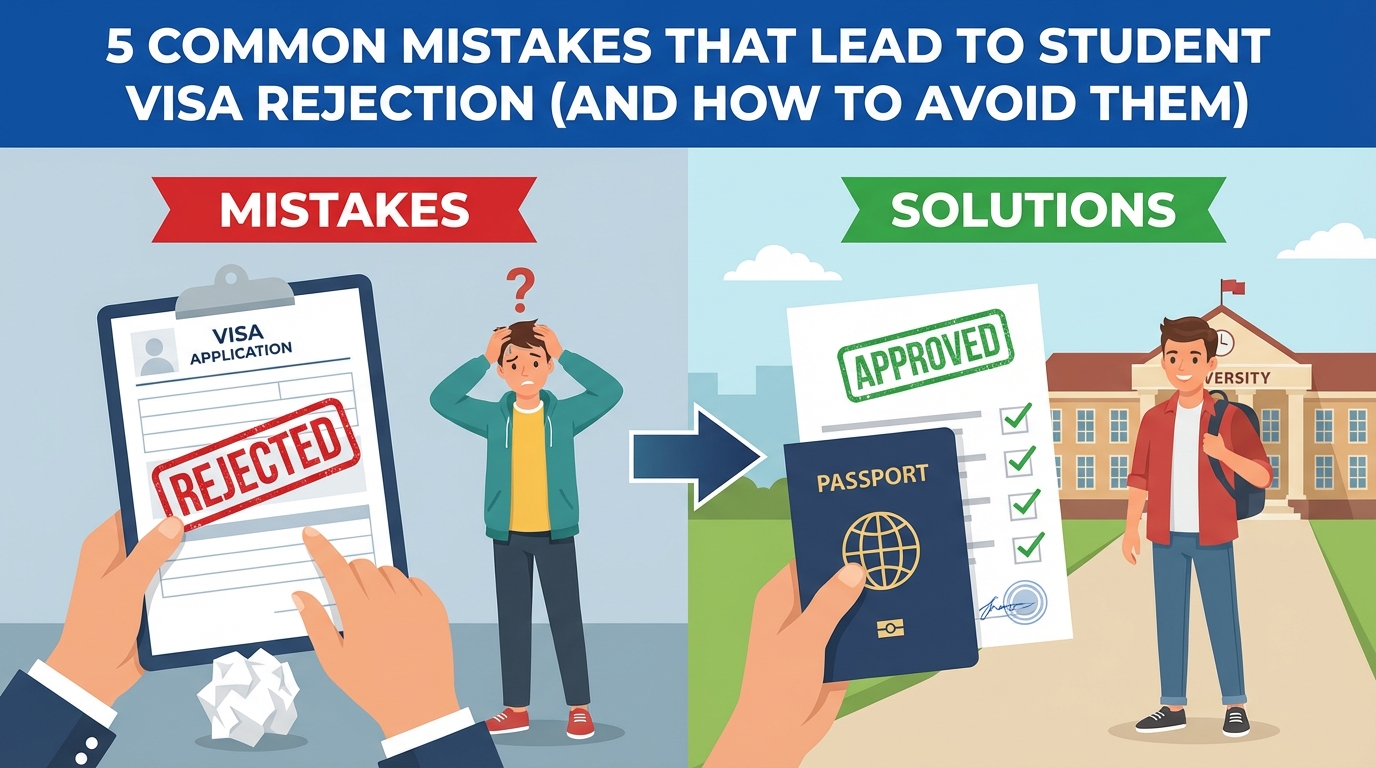
In this guide, you will learn the five most common reasons visas are denied and, more importantly, the precise steps to ensure your application is airtight. We will move beyond general advice and look at the technical details that actually matter to immigration officers.
Mistake 1: The “Lump Sum” Deposit (Financial Inconsistency)
The number one reason for student visa rejection is not “lack of money,” but “unexplained money.” Immigration officers are trained to spot “funds parking”—where a student or parent suddenly deposits a large amount of money (e.g., $30,000) into an account just weeks before the interview.
The Fix: Build a Financial History You must prove that the money is genuinely yours (or your sponsor’s) and has been accumulated over time through legitimate income.
- Bank Statement Strategy: Submit 6 months of statements, not just a balance certificate.
- Proof of Source: If there is a large recent deposit, you must attach evidence of its origin (e.g., sale of land, maturity of a fixed deposit, or a severance package).
- Sponsorship Logic: If your uncle is sponsoring you, you must explain why. Officers often doubt that a distant relative will spend $40,000 on your education. Parents are the safest sponsors.
Pro Tip: If your sponsor is a business owner, do not just submit a personal bank statement. You must include business registration documents and tax clearance certificates to prove the business actually exists and generates that revenue.
Mistake 2: Failing the “Academic Progression” Test
Consular officers are academic snobs. They want to see that your proposed course makes sense in the context of your previous education and career. If you studied History in your undergraduate degree and are now applying for a Master’s in Cyber Security without any work experience in IT, you will likely be rejected.
The Fix: Connect the Dots Your study plan must look like a natural next step, not a desperate attempt to leave the country.
- Same Field: If changing careers, you need a strong “Bridge.” This could be a Postgraduate Diploma (PGD) or relevant work experience certificates.
- Course Level: Never apply for a course at a lower level than you already possess (e.g., applying for an Associate Degree when you already have a Bachelor’s).
- Gap Explanation: If you have a study gap of 3+ years, you must show professional evidence (employment letters, payslips) for that period.
Pro Tip: In your Statement of Purpose (SOP) and interview, explicitly state: “This Master’s in Public Health builds upon my 3 years of experience as a volunteer health worker in Lagos, allowing me to specialize in Epidemiology.”
Mistake 3: Weak “Home Ties” (Section 214b)
For US visas specifically, Section 214(b) is the most common rejection code. It means: “You did not convince me you will return home.” If you sound like you are dying to escape your country, you will be denied.
The Fix: The “Return Plan” You cannot just say “I will come back.” You need to show economic and social anchors.
- Career Prospects: Bring printouts of job advertisements in your home country that require the degree you are going to get. This proves there is a market for your skills back home.
- Assets: If your family owns property, bring the documents.
- Family Structure: If you are the only child or have aging parents, mention your responsibility to care for them (culturally appropriate in many developing nations).
Pro Tip: Avoid saying “I hope to work for Google in California after I graduate.” Instead, say: “I plan to bring this technical knowledge back to the growing FinTech sector in [Your City], where companies like [Company A] and [Company B] are actively hiring professionals with this qualification.”
Mistake 4: The “Scripted” Interview
Officers interview hundreds of students a day. They know exactly when you have memorized an answer from a WhatsApp group or an agent. If you sound robotic, they assume you are hiding something.
The Fix: Active Listening and Direct Answers
- Listen to the Question: If they ask “Who is paying for your trip?”, do not give a 2-minute speech about your father’s job. Just say: “My father, Mr. John Doe.”
- Know Your Course: You must know the names of your specific modules or classes. Don’t just say “I am going to study Business.” Say “I am particularly interested in the Supply Chain Analytics module offered in the second semester.”
Pro Tip: Practice with a friend who will interrupt you. The officer will often cut you off mid-sentence. If you get flustered when interrupted, it looks like you lost your script.
Mistake 5: Inconsistent Data (The “Silent Killer”)
This is a technical error that destroys credibility instantly. If your DS-160 form says you worked at “Company A” starting in 2022, but your LinkedIn profile says 2023, and your CV says 2021, you are in trouble.
The Fix: The Triple Audit Before you submit anything, ensure these three documents tell the exact same story:
- Visa Application Form (DS-160 / UK VI Form)
- CV / Resume
- Social Media (LinkedIn)
- Dates: Check start and end dates for every job.
- Titles: Ensure your job title is the same everywhere.
- Spelling: Your name must match your passport exactly.
Pro Tip: Print your application form before submitting it. Read it backward (from the last question to the first). This tricks your brain into spotting typos you might miss when reading normally.
“Sample/Template” Section: The Pre-Interview Audit Checklist
Do not walk into the embassy without passing this audit. Copy this into a document and check off every item.
Plaintext
### VISA INTERVIEW DOCUMENT AUDIT CHECKLIST

1. PASSPORT & FORMS
[ ] Passport valid for at least 6 months beyond intended stay.
[ ] Visa Application Confirmation Page (DS-160 / CAS Statement).
[ ] Interview Appointment Letter.
[ ] SEVIS Fee Receipt (I-901) - *For US Applicants*.

2. ACADEMIC DOCUMENTS
[ ] Original Degree Certificate (Bachelor's/HND).
[ ] Official Transcripts (Sealed if possible).
[ ] Standardized Test Scores (GRE/GMAT/IELTS/TOEFL) - even if optional, bring them.
[ ] Resume/CV (Updated and matching the application form).

3. FINANCIAL DOCUMENTS
[ ] 6 Months of Bank Statements (Signed/Stamped by the bank).
[ ] Affidavit of Support (Notarized).
[ ] Sponsor's Employment Letter / Business Registration.
[ ] Tax Clearance Certificate for the Sponsor.
[ ] Valuation of Assets (Landed property, stocks, etc.).

4. THE "STORY" CHECK
[ ] Can I explain why I chose this specific university over 5,000 others?
[ ] Can I explain a specific gap in my resume (e.g., 2023-2024)?
[ ] Do I know the name of my Sponsor's company and what they actually sell/do?
Common Mistakes to Avoid (Behavioral)
- Over-Dressing or Under-Dressing: Do not wear a tuxedo, but do not wear a tracksuit. Aim for “Business Casual.” You want to look like a serious student. A simple button-down shirt and trousers work best.
- Handing Over Documents Unasked: Do not shove a pile of papers through the window the moment you arrive. Wait for the officer to ask for a specific document. Handing over papers unprompted makes you look desperate.
- Looking at the Translator (if applicable): If you are using an interpreter, always look at the Officer, not the interpreter. Eye contact with the decision-maker shows confidence and honesty.
FAQ
1. If my visa is rejected, can I reapply immediately? Yes, technically you can reapply as soon as you can get a new appointment. However, doing so without changing anything in your application usually leads to another rejection. You should only reapply if your circumstances have changed or if you can provide significant new evidence that was missing the first time.
2. Does using a travel agent guarantee a visa? No. In fact, many “agents” in Nigeria and India harm your application by using generic templates or fake documents that the embassy has already flagged. It is almost always better to fill out the forms yourself so you know exactly what is in them. If you use a consultant, ensure they are guiding you, not falsifying data for you.
3. Is it better to say I have relatives in the US/UK or hide it? Always tell the truth. The embassy often has records of your relatives. If you lie and say you have no relatives, and they find out your brother lives in Texas, you will be banned for visa fraud. Admit you have relatives, but emphasize that you are going there to study, not to live with them.