Receiving a study visa refusal—whether from the US, UK, Canada, or Australia—is a heavy emotional blow. For many students in developing countries like Nigeria or India, this is not just a rejected application; it feels like a door closing on years of planning and significant financial investment.
However, a refusal is not necessarily the end of the road. In the world of international education, it is often a request for more information. Consular officers handle thousands of applications; if your “story” didn’t align or your documentation was vague, they default to a refusal to protect their borders.
In this guide, you will learn the exact mechanics of appealing a decision through a Letter of Reconsideration or Administrative Review. We will break down how to identify the “pain points” in your refusal letter, how to address them with evidence, and how to structure a response that commands professional respect.
Step 1: Deconstruct the Refusal Letter
Before you write a single word, you must understand exactly why you were rejected. Most countries provide a “refusal narrative” or specific checkboxes (like Section 214(b) for the US or Paragraph 245V for the UK).
Common Refusal Grounds:
- Lack of Ties to Home Country: The officer believes you won’t return after your studies.
- Insufficient Funds: Your bank statements don’t clearly show a liquid path from the sponsor to the university.
- Vague Study Plan: You couldn’t explain why this specific degree helps your career in your home country.
Pro Tip: Do not take the refusal personally. Treat the refusal letter as a “gap analysis.” Every reason they gave is a specific problem you need to solve with a new document or a clearer explanation.
Step 2: Gather “Fresh” Evidence
An appeal is rarely successful if you simply resubmit the same documents. You need to provide “additional context” or “rectified evidence.” If they questioned your finances, a simple bank statement might not be enough; you may need a property valuation or a more detailed affidavit of support.
Documentation Checklist for the Appeal:
- The Original Refusal Letter: To reference specific points.
- Updated Financial Records: Recent statements (usually not older than 7 days from the appeal date).
- Proof of Strong Ties: Employment letters, landed property titles, or family business registrations.
- Academic Credibility: A fresh letter from your University Program Head supporting your candidacy.
Pro Tip: If your refusal was based on “Funds,” ensure your sponsor’s source of income is crystal clear. If they are a trader, include business registration and tax receipts, not just a lump sum deposit.
Step 3: Drafting the Reconsideration Letter
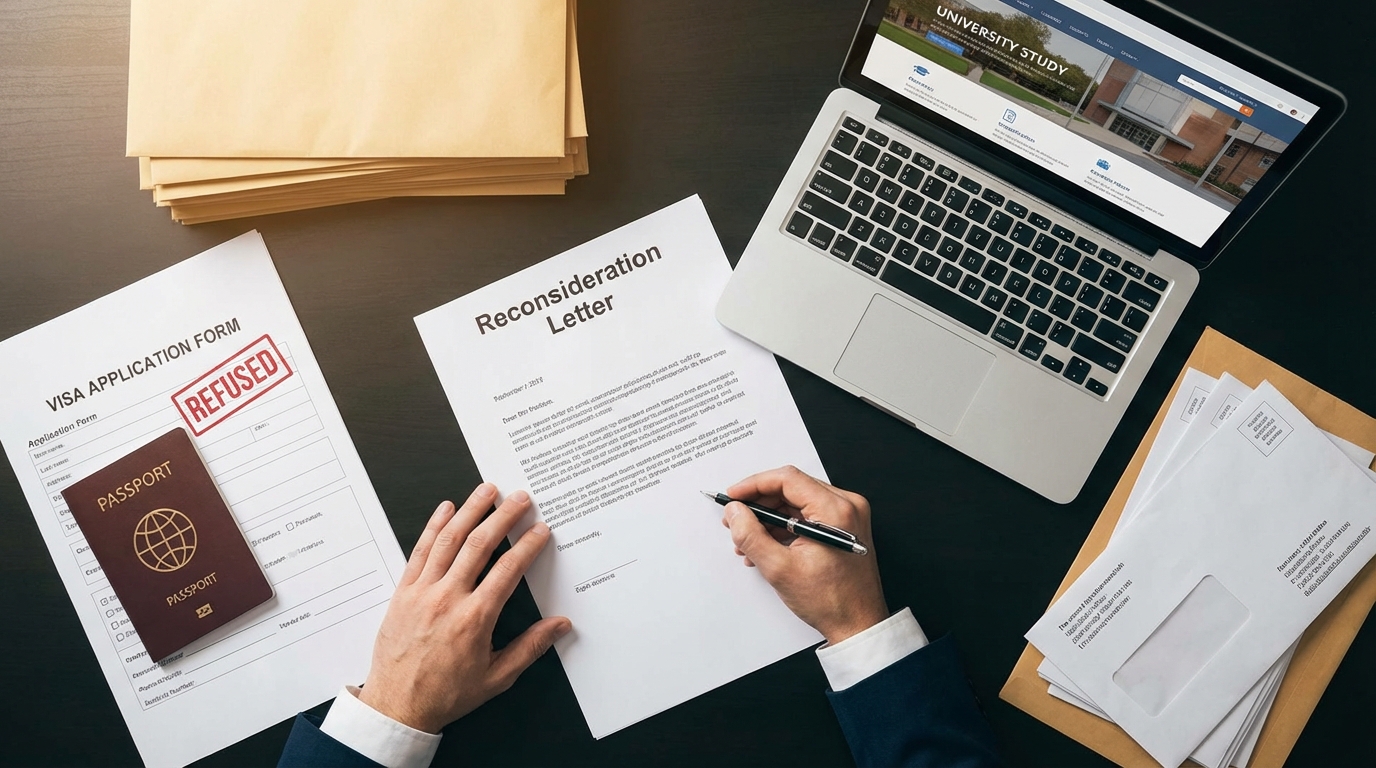
Your letter should be a formal, legalistic, yet persuasive document. It is not an emotional plea; it is a factual argument. You are showing the officer that their previous decision was based on incomplete information which you are now providing.
Structure of the Letter:
- Header: Case number, Passport number, and Full Name.
- The Opening: State clearly that you are requesting a reconsideration.
- The Rebuttal: Address each refusal point one by one.
- The Conclusion: Reiterate your intent to study and return home.
Pro Tip: Use “active voice.” Instead of saying “It was felt that I lacked ties,” say “I am providing my Deed of Assignment to demonstrate my significant economic ties to Lagos.”
Step 4: The Sample Reconsideration Template
Use the template below as a framework. Do not copy it word-for-word. You must adapt it to your specific refusal reasons.
Plaintext
[Your Full Name]
[Your Address]
[Passport Number]
[Visa Application Reference Number]

[Date]

To: The Visa Section,
[Name of Embassy/Consulate, e.g., British High Commission]
[Address of Embassy]

SUBJECT: REQUEST FOR RECONSIDERATION REGARDING STUDY VISA REFUSAL - [Your Name]

Dear Consular Officer,

I am writing to formally request a reconsideration of the decision made on [Date of Refusal] regarding my application for a [Type of Visa, e.g., Tier 4 Student Visa]. I respect the diligent work of the High Commission; however, I believe that the refusal was based on a misunderstanding of my circumstances which I have clarified through the attached evidence.

ADDRESSING GROUNDS OF REFUSAL:

1. Regarding "Insufficient Ties to Home Country":
The refusal letter noted a concern that I might not return to Nigeria post-graduation. To address this, I have attached [Document Name, e.g., a Letter of Leave of Absence] from my current employer, [Company Name], which guarantees my position as Senior Analyst upon my return. Furthermore, I have included titles for properties I own in [City], valued at [Amount].

2. Regarding "Source of Funds":
The officer noted that the origin of the initial deposit in my sponsor's account was unclear. I have now included [Document Name, e.g., Dividend Warrants/Business Invoices] which clearly trace these funds to my sponsor's legitimate business operations over the last six months.

CLOSING STATEMENT:
My sole intention is to acquire the specialized skills offered by the [Degree Name] at [University Name] to contribute to the [Specific Industry] in my home country. I have strictly followed all immigration rules in the past and intend to do so during my stay.

Thank you for your time and for reviewing my application again.

Sincerely,

[Your Signature]
[Your Phone Number]
[Your Email Address]
Common Mistakes to Avoid
- The “Emotional” Appeal: Avoid phrases like “This is my only dream” or “My life will be over if I don’t get this.” Consular officers make decisions based on law and policy, not sympathy. Stick to the facts.
- Ignoring the “Six-Month” Rule: Many students submit bank statements that show a sudden “lump sum” deposit right before the application. This is a massive red flag. If you cannot explain where the money came from, do not appeal until you can.
- Generic Responses: Using a template without changing the details is a fast track to a second rejection. You must address the exact sentence used in your refusal letter.
FAQ (Frequently Asked Questions)
1. How long does a reconsideration take? The timeline varies significantly by country. For the UK, an Administrative Review can take 28 days or longer. For the US, there is no formal “appeal” for most student visas; instead, you usually re-apply for a new interview. Check the official government website for the most current processing times.
2. Should I hire a lawyer to write the letter? While not mandatory, a qualified immigration consultant can help identify legal errors in a refusal. However, if the refusal was based on a lack of documents, you can often handle this yourself by simply providing the missing evidence.
3. Does an appeal guarantee I will get the visa? No. An appeal or reconsideration request only increases your chances by ensuring the officer has the full picture. The final decision remains at the discretion of the consular office based on the immigration laws of that country.