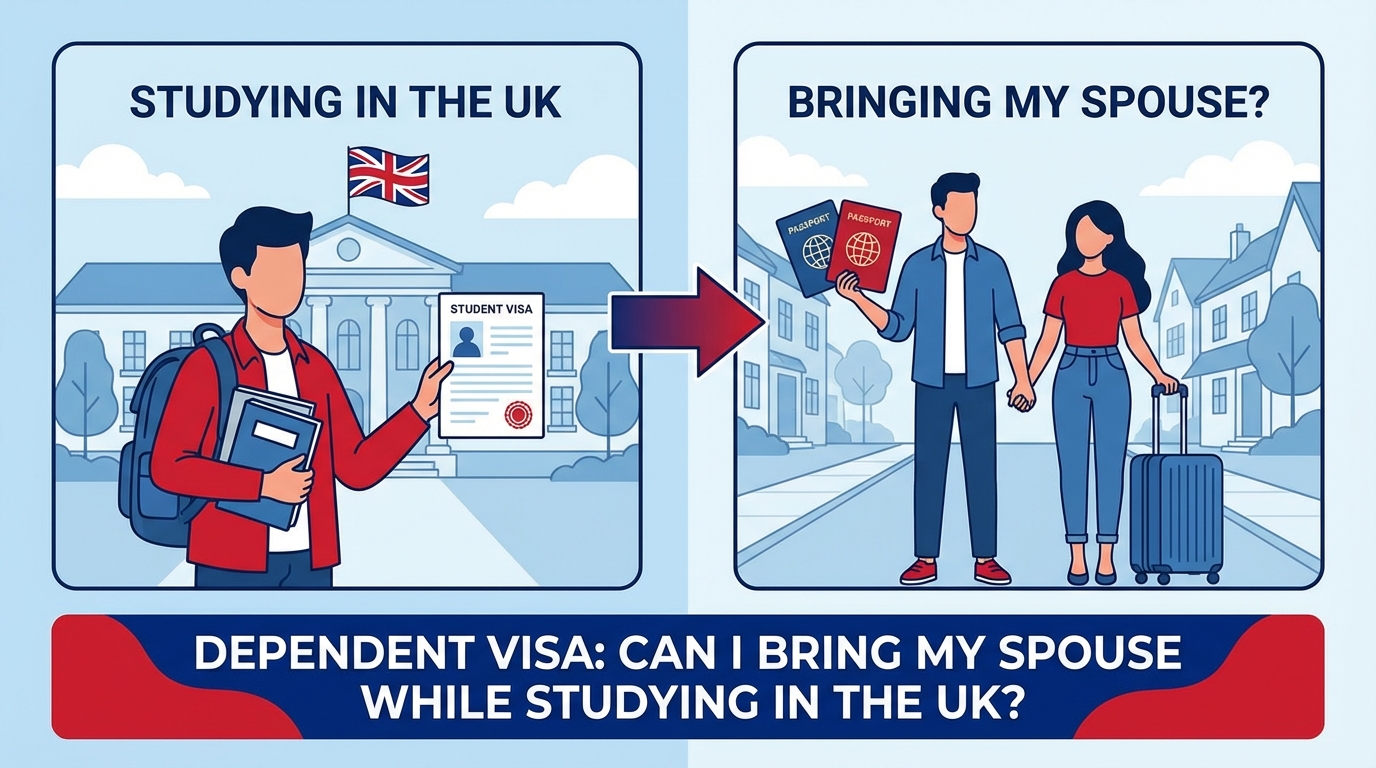
For many international students in Nigeria, India, and beyond, the dream of studying in the UK isn’t just about an individual degree—it’s about a family’s future. In the past, “bringing the family” was a standard part of the UK study experience.
However, we must start with a firm reality check: The rules for UK Dependent Visas changed significantly in 2024 and remain strict as we head into 2026. Most students on one-year “Taught” Master’s programs (like an MBA or an MSc in Management) can no longer bring their partners or children to the UK.
This guide will move past the confusion. You will learn exactly who is still eligible, how to prove your “genuine relationship” to the Home Office, and the precise financial thresholds you must hit in 2026 to ensure your family can join you legally.
Step 1: Confirm Your Eligibility
Before spending thousands on application fees, you must ensure your course allows for dependents. As of 2026, the Home Office has narrowed the gate to specific types of high-level research.
Who CAN bring dependents:
- Postgraduate Research Students: You must be enrolled in a PhD, a Doctoral qualification, or a Research-based Master’s (like an MPhil or MRes).
- Government-Sponsored Students: If you have a full scholarship from your national government or the UK government (e.g., Chevening or Commonwealth) for a course longer than 6 months.
- Existing Dependents: If you are already in the UK and are extending your visa for the same course.
Who CANNOT bring dependents:
- Undergraduate students.
- Postgraduate Taught (Master’s) students (unless government-sponsored).
Pro Tip: Look at your Confirmation of Acceptance for Studies (CAS). For your spouse to qualify, the “Course Level” field must explicitly state “RQF 7 – Research” or “RQF 8 – Research.”
Step 2: Calculate Your 2026 Maintenance Funds
The “Financial Requirement” is the number one reason for visa rejections. You must prove you have enough money to support your family without “recourse to public funds.”
Maintenance Requirements (per person):
- In London: £845 per month (up to a maximum of 9 months).
- Outside London: £680 per month (up to a maximum of 9 months).
Total Funds Needed for One Dependent (Outside London):
$9 \text{ months} \times £680 = £6,120$
Requirement Checklist:
- The 28-Day Rule: The full amount must be in your bank account for a minimum of 28 consecutive days.
- Account Ownership: The funds can be in the student’s name, the partner’s name, or both (jointly).
- Currency: If the money is in Naira or Rupees, use the official OANDA exchange rate for the date of application.
Pro Tip: Never let your balance dip below the required amount for even one second. If your bank charges a small service fee that takes your balance from £6,120 to £6,119.99, the Home Office will reject the visa. Always keep a £500 “buffer” in the account.
Step 3: Prove the Relationship is “Genuine and Subsisting”
It is not enough to show a marriage certificate. The Home Office is looking for “sham marriages.” You must prove that your life is intertwined.
Relationship Requirements:
- Married Partners: A valid marriage certificate (translated into English if necessary).
- Unmarried Partners: You must prove you have lived together for at least two years.
- Children: Must be under 18 and not “leading an independent life” (e.g., they aren’t married or working full-time).
Evidence to Include:
- Joint bank statements or utility bills.
- Family photos from various years (holidays, weddings, family gatherings).
- A shared tenancy agreement or property title.
Pro Tip: If you have recently married specifically to travel together, the “genuine and subsisting” requirement is harder to meet. Include chat logs, travel bookings, and photos spanning your entire dating period to show the relationship predates the visa application.
Step 4: The Application and Health Surcharge (IHS)
The cost of a dependent visa is significant. In 2026, you must pay both the application fee and the Immigration Health Surcharge (IHS), which grants your family access to the NHS.
Fees Breakdown (Approximate for 2026):
- Visa Application Fee: £490 per person.
- Immigration Health Surcharge (IHS): Approximately £776 per year per dependent.
- Tuberculosis (TB) Test: Required if you are applying from Nigeria, India, or other listed countries.
Pro Tip: You can apply for your spouse at the same time as your student visa or after you have arrived in the UK. Applying together is often smoother as the officer reviews the “family unit” as a single case.
Sample/Template: Dependent Document Checklist
Copy this checklist into your notes. Every “No” in the “Provided?” column is a high risk for rejection.
| Document Category | Document Required | Provided? |
| Identity | Valid Passport (at least 6 months validity) | [ ] |
| Health | Valid TB Test Certificate from an approved clinic | [ ] |
| Main Applicant | Copy of the Student’s CAS and current Visa/BRP | [ ] |
| Financial | 28 days of Bank Statements showing £6,120+ (Outside London) | [ ] |
| Relationship | Marriage Certificate (Original + Translated) | [ ] |
| Relationship | 5-10 Photos showing the timeline of the relationship | [ ] |
| Relationship | Evidence of joint address (Bills/Tenancy) | [ ] |
| Accommodation | Letter from UK Landlord or Tenancy Agreement for the family | [ ] |
Common Mistakes to Avoid
- “Funds Parking”: Depositing a large sum of money from a friend’s account into yours just before the 28-day window starts. If there is a massive “unexplained” deposit, the officer may flag it as “funds not genuinely available.”
- Missing Translations: Every document not in English (especially marriage or birth certificates) must have a certified translation. Self-translations are not accepted.
- Sole Responsibility Issues: If you are bringing a child but the other parent is staying in your home country, you must prove you have “sole responsibility” for the child. This is a very high legal bar and usually requires court documents or proof of the other parent’s total absence.
FAQ
1. Can my spouse work in the UK while I study?
Yes. In most cases, the partner of a student on a Research-level program has “full right to work.” They can work any hours, in any sector, except as a professional sportsperson or doctor/dentist in training (unless qualified).
2. Can my child attend school for free?
Yes. Children aged 5 to 16 are eligible for free state education in the UK while they hold a valid dependent visa. You should check the local council website of the city where you will live to understand the enrollment process.
3. What happens to my family’s visa if I fail my course?
The dependent visa is strictly tied to the main student’s visa. If your student visa is cancelled or curtailed, your family’s visas will also be curtailed, and they will be required to leave the UK at the same time as you.