Studying in the USA is a massive financial gamble. For a student from Lagos, Mumbai, or Accra, the tuition fees alone can be upwards of $30,000 to $60,000 per year. When you factor in living expenses, the numbers are terrifying.
Most students assume that once they graduate, they can easily stay and work to recover this investment. This is false.
The standard work permit for international graduates—called Optional Practical Training (OPT)—lasts for only 12 months. That is barely enough time to settle into a job, let alone save significant money or secure a work visa (H-1B). One year flies by. If you do not secure a visa sponsorship in that short window, you must pack your bags and leave.
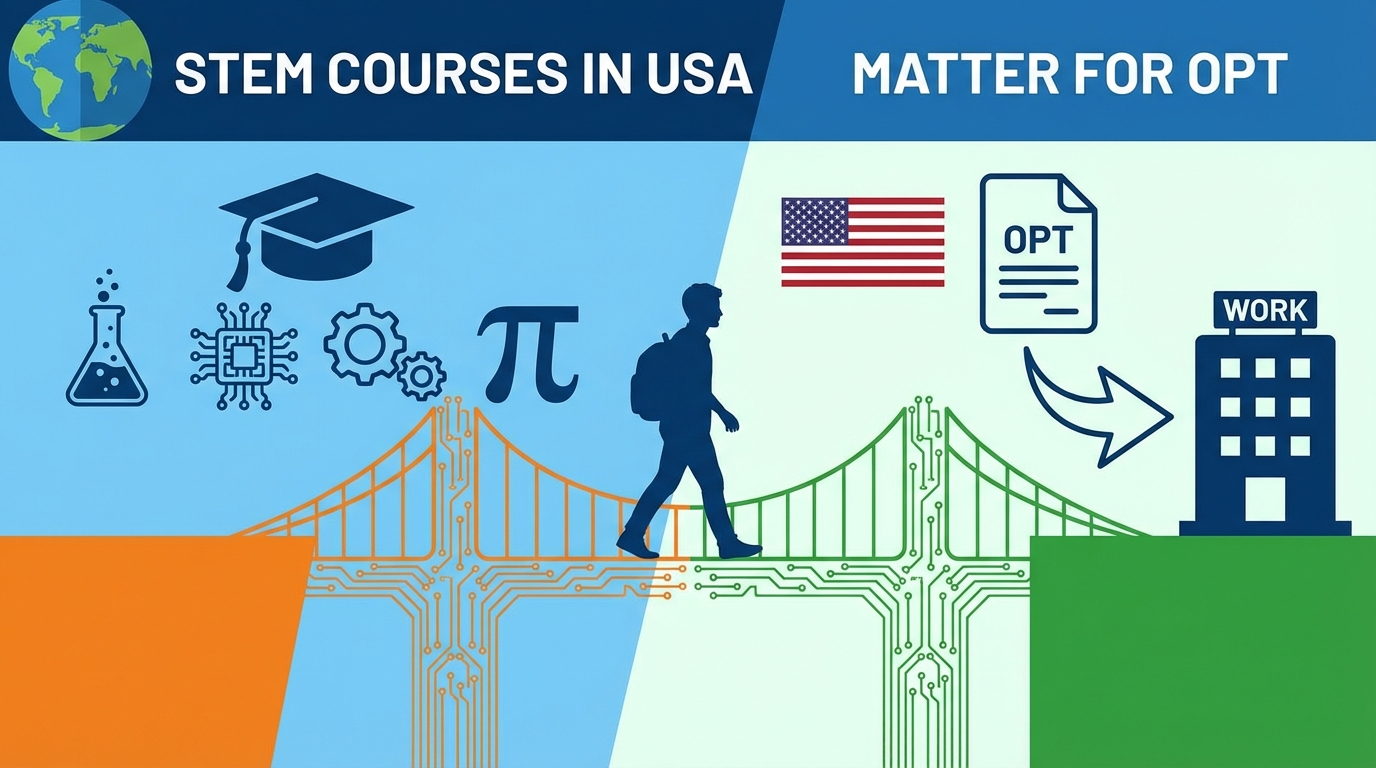
However, there is a legal “loophole” designed by the US government to attract talent: the STEM OPT Extension. This allows specific graduates to stay and work for an additional 24 months, totaling 3 years of work authorization.
In this guide, you will learn exactly what a STEM designation is, why it is the single most important factor when choosing a US university, and how to verify if your course qualifies.
Step 1: Understand the Mathematics of “OPT”
Before you pick a major, you must understand the visa timeline. This is not just about education; it is about immigration strategy.
The Standard OPT (12 Months)
- Who gets it: Almost every F-1 international student who completes a degree (Bachelor’s, Master’s, or PhD).
- Duration: 1 year.
- The Risk: If your employer applies for an H-1B visa (the dual-intent work visa) for you, it is a lottery system. You have roughly a 20-30% chance of being selected. With only one year of OPT, you usually get only one shot at this lottery. If you miss it, you often have to go home.
The STEM Extension (24 Additional Months)
- Who gets it: Only students graduating with a degree on the “STEM Designated Degree Program List.”
- Duration: 1 year (Standard) + 2 years (Extension) = 3 Years Total.
- The Advantage: With 3 years of work authorization, you get three shots at the H-1B visa lottery. This drastically increases your statistical probability of securing a long-term future in the US.
Pro Tip: Don’t just “hope” your course is STEM. The US Department of Homeland Security (DHS) maintains a strict list. If your degree isn’t on it, you don’t get the extension. No exceptions.
Step 2: Decode the “CIP Code” (The Secret Identifier)
This is the technical detail that 90% of students miss.
University marketing brochures can call a degree whatever they want. They might call a course “Master’s in Digital Transformation.” That sounds technical, right? But for immigration purposes, the name doesn’t matter. The CIP Code matters.
What is a CIP Code? The “Classification of Instructional Programs” (CIP) is a numerical code assigned to every degree in the US.
- Where to find it: It is usually listed on the university’s website under “International Student Resources” or, if you are already admitted, on your I-20 form.
- The format: It looks like
XX.XXXX(e.g.,11.0701for Computer Science).
How to verify eligibility:
- Find the CIP code for your specific program.
- Check it against the official DHS STEM Designated Degree Program List.
- If the code matches, you are eligible for the 3-year stay.
Pro Tip: Be careful with “Management” degrees. A “Master’s in Management” is often not STEM. However, a “Master’s in Management Information Systems” or “Quantitative Management” usually is STEM. The curriculum focus makes the difference.
Step 3: Look Beyond Engineering (STEM for Non-Coders)
Many students from Nigeria or India believe STEM is only for engineers or doctors. This is outdated. US universities have adapted their curriculum to include “quantitative” elements in business and arts degrees to make them STEM-eligible.
Common “Hidden” STEM Degrees:
- Business:
- Business Analytics
- Financial Engineering / Quantitative Finance
- Supply Chain Management
- Economics (often classified as “Econometrics and Quantitative Economics”)
- Arts/Design:
- Digital Arts (if it involves significant coding/tech)
- Instructional Technology
- Media Forensics
Requirements to maintain the Extension: Once you graduate and start working on your STEM extension, the rules get stricter:
- E-Verify Employer: You can only work for companies enrolled in the US government’s E-Verify program. (Most large MNCs are; many small startups are not).
- Training Plan (Form I-983): You and your employer must fill out a training plan detailing exactly what skills you are learning.
- Paid Work Only: On standard OPT, you can volunteer. On STEM OPT, you must be paid.
Pro Tip: If you are a Marketing student, look for “Marketing Analytics” or “Marketing Science” degrees. These are often STEM-designated because they focus on data, whereas a general “Marketing” degree is usually not.
Sample/Template: The “CIP Verification” Email
Do not assume a course is STEM-designated just because it involves computers. Ask the admissions office directly before you pay your deposit.
Copy and adapt this email template.
Plaintext
Subject: Inquiry regarding STEM Designation and CIP Code for [Program Name] - [Your Name]

Dear [University Name] Admissions Team,

My name is [Your Name] and I am a prospective student from [Country] interested in the [Full Name of Degree, e.g., Master of Science in Finance] program.

As an international student, post-graduation work authorization is a critical factor in my decision-making process.

Could you please confirm the specific Classification of Instructional Programs (CIP) code for this degree?

Specifically, I would like to confirm if this program is currently classified as a STEM-designated degree program eligible for the 24-month OPT extension under DHS regulations.

Thank you for your time and guidance.

Sincerely,

[Your Name]
[Your Phone Number]
Common Mistakes to Avoid
- Ignoring the “unemployment clock”: On standard OPT, you have 90 days of unemployment allowed. On STEM OPT, you get an extra 60 days, totaling 150 days for the entire 3-year period. If you stay unemployed for 151 days, your visa status is automatically terminated. Students often quit a job without having another lined up, burning through these days too quickly.
- Working for a non-E-Verify employer: You might get a great job offer from a cool boutique agency. If they are not in E-Verify, you cannot use your STEM extension with them. You would have to leave them after year 1. Always ask during the interview process: “Is your company enrolled in E-Verify?”
- Failing to Report Changes: During the STEM extension, you must validate your employment status with your university’s Designated School Official (DSO) every 6 months. If you move houses or change phone numbers and forget to update the portal, your record can be flagged, and you could lose your status.
FAQ
Q: Can I do a STEM extension if I have a non-STEM degree? A: Generally, no. The job you do must be directly related to the STEM degree you earned. However, if you earned a STEM degree in the US previously (e.g., a Bachelor’s in Math) and just finished a non-STEM Master’s (e.g., MBA), you might be able to use the previous Bachelor’s degree to apply for the extension, provided the job relates to the Math degree. This is complex; consult a DSO.
Q: Does a STEM degree guarantee an H-1B visa? A: No. A STEM degree gives you time, not a guarantee. It gives you 3 years to work. In those 3 years, your employer can enter you into the H-1B lottery 3 times. This statistically increases your chances of selection, but it does not guarantee it.
Q: Are STEM courses harder to get into? A: Not necessarily “harder,” but they often have specific prerequisites. For example, a STEM-designated Master’s in Finance might require you to have taken Calculus or Statistics during your Bachelor’s degree. Always check the “Prerequisites” section of the course page.