Let’s be honest: You worked hard for your degree. You survived ASUU strikes (if in Nigeria), rigorous exams (if in India), and years of study. But to a US or Canadian admissions officer, your “First Class Honours” or “10-Point CGPA” is just a number they don’t understand.
They don’t know if a 7.0 CGPA is excellent or average. They don’t know if your “3-year Bachelor’s” is equivalent to their “4-year Bachelor’s.”
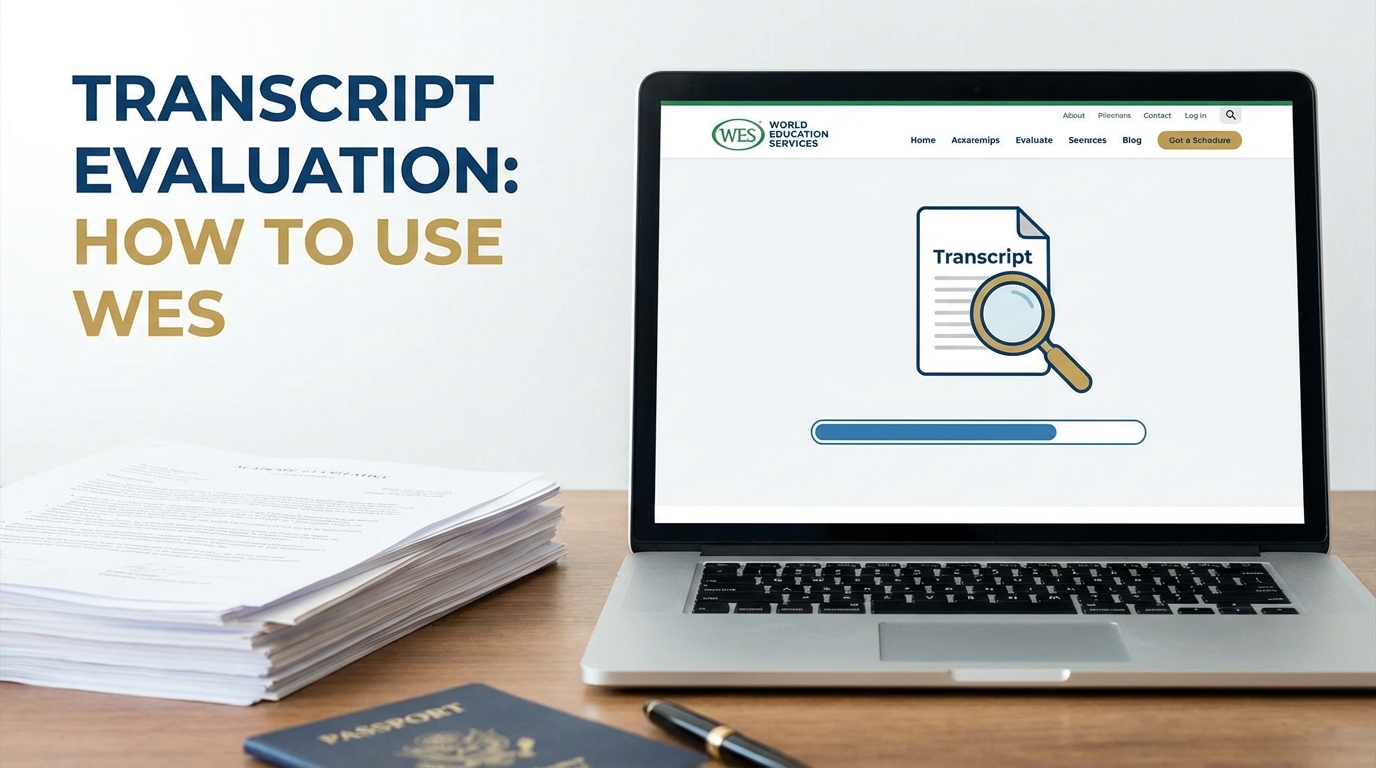
That is where WES (World Education Services) comes in. They are the translators. They take your local transcript and convert it into the US/Canada 4.0 GPA scale. Without this, your application to many universities is dead on arrival.
In this guide, you will learn exactly how to navigate the WES process without wasting money on the wrong report or getting stuck in the dreaded “Awaiting Verification” limbo for months.
Step 1: Choose the Right “Product” (Don’t Buy the Cheapest One)
WES sells two main types of evaluations. Choosing the wrong one is the most common reason students lose $200+.
1. Document-by-Document (DxD)
- What it does: Describes your degree (e.g., “Equivalent to a US Bachelor’s”).
- Who it is for: Immigration (e.g., Canada Express Entry), Employment.
- Verdict: Do NOT buy this if you are applying for a Master’s degree.
2. Course-by-Course (CxC)
- What it does: Lists every single subject you took (Math 101, Chem 202), converts the grade for each subject, and calculates a final GPA (e.g., 3.4/4.0).
- Who it is for: Graduate School Admissions, Licensing Boards.
- Verdict: Buy this. Most universities strictly require the CxC report.
Pro Tip: The “ICAP” Secret When checking out, you will see an option for WES ICAP (International Credential Advantage Package). It costs about $50 extra. Pay it.
- Basic: WES evaluates your transcript and sends the report. They do not store your verified transcript for future use.
- ICAP: WES evaluates your transcript and stores the verified copy forever. If you apply to 5 more schools later, WES can send the verified transcript immediately without you asking your Nigerian/Indian university to send it again (which is a nightmare).
Step 2: Create Your Account & Get the “Golden Number”
Go to wes.org and create an account. You will pay the fee (approx. $170 – $220 USD depending on the package).
Once you pay, you will receive a WES Reference Number (e.g., 1234567).
Write this number down. Tattoo it on your arm if you have to. This number is the oxygen of your application. If any document reaches WES without this number written on it, it goes into a trash pile (or a very slow sorting room), and you will likely never hear about it again.
Step 3: The “Official” Transcript Handover
This is where 90% of students from developing countries fail.
The Rule: You cannot send your own transcript to WES. Even if you have a sealed copy in your hand, WES will reject it. It must come directly from your university.
Option A: The Digital Route (Fastest) WES has integrated with digital platforms in many countries.
- Nigeria: Many universities use ETX-NG. You go to the ETX-NG portal, select your school, pay the fee, and they transmit your transcript digitally to WES.
- India: Many universities use Truecopy, DirectVerify, or have their own digital portal listed on the WES website.
Option B: The Physical Route (Slow & Risky) If your school is old-school (analog), you must:
- Go to your university Registrar.
- Pay for an “Official Transcript.”
- Give them the “Academic Records Request Form” (downloadable from your WES dashboard).
- Ensure they put the transcript and the form in an envelope.
- CRITICAL: They must seal the envelope and stamp/sign across the back flap.
- CRITICAL: They must write your WES Reference Number on the outside of the envelope.
Pro Tip: Do not let the university use the local post office (NIPOST/India Post) if possible. It can take months. Pay extra for a courier (DHL/FedEx) and get the tracking number yourself.
Step 4: The “Verification” Trap
After WES receives your transcript, they might pause and say: “Waiting for Verification.”
This means WES has sent an email (or letter) back to your university asking: “Did you really issue this transcript?”
Your evaluation stops until your university replies. In many Nigerian/Indian public universities, this email goes to a generic inbox (e.g., registrar@uni.edu.ng) that nobody checks. You must physically go (or send someone) to the Registrar’s office to remind them to reply to the WES verification email.
Sample/Template: The “Registrar Follow-Up” Email
If you are using the physical route or tracking a delay, send this to your university’s Exams & Records officer.
Plaintext
Subject: URGENT: Transcript Transfer for [Your Name] - Matric No: [Your ID]

Dear [Name of Registrar or "Exams Officer"],

My name is [Your Name] (Matriculation Number: [Your ID]). I recently paid for my official transcript to be sent to World Education Services (WES) for my Master's application.

I am writing to confirm two critical details to ensure the transcript is not rejected:

1. WES REFERENCE NUMBER: Please ensure my Reference Number [Insert WES Ref #] is written clearly on the OUTSIDE of the envelope. WES will destroy the package if this number is missing.

2. SEAL & STAMP: Please ensure the envelope is sealed and signed/stamped across the back flap.

If the transcript is being sent digitally/via email, please include the Reference Number in the email subject line.

Thank you for your assistance in helping me further my education.

Sincerely,

[Your Name]
[Phone Number]
Common Mistakes to Avoid
- Sending Your Personal Copy: You scan the transcript you have at home and upload it or mail it.
- Result: WES will update your status to “Document Received” but then “Rejected/Unofficial.” You wasted shipping money.
- Using the “Immigration” Report for “Education”: You buy the cheaper “Document-by-Document” report to save $50.
- Result: The US University admissions office emails you: “We need a course-by-course breakdown to see your GPA.” You now have to pay WES for an “Upgrade,” which costs more than if you had bought the right one initially.
- Ignoring the “Name Mismatch”: Your passport says “Chinedu Emmanuel Okafor” but your university transcript says “Okafor Chinedu E.”
- Result: WES pauses the evaluation.
- Fix: When creating your WES account, list all “variations” of your name used on documents. If the difference is major (e.g., maiden name vs. married name), upload your Marriage Certificate or Affidavit of Name Change immediately.
FAQ
Q: My CGPA in Nigeria is 3.5/5.0. What will it be in the US? A: There is no single formula, but typically:
- A First Class (4.5–5.0) usually translates to a 4.0 GPA.
- A Second Class Upper (3.5–4.49) usually translates to a 3.0 – 3.7 GPA.
- Note: WES is sometimes generous. They may ignore “D” grades in irrelevant electives if your core courses are strong, boosting your GPA slightly.
Q: Can I send my WAEC/NECO/Year 12 results to WES? A: Generally, no. For a Master’s degree evaluation, WES only wants your post-secondary (University) documents. Do not send high school results unless they explicitly ask for them (which is rare for Graduate evaluations).
Q: How long does WES take? A: Once they receive and verify your documents, the standard processing time is 7 business days. However, the total time (including shipping from your country and verification delays) is usually 4 to 8 weeks. Start early.